
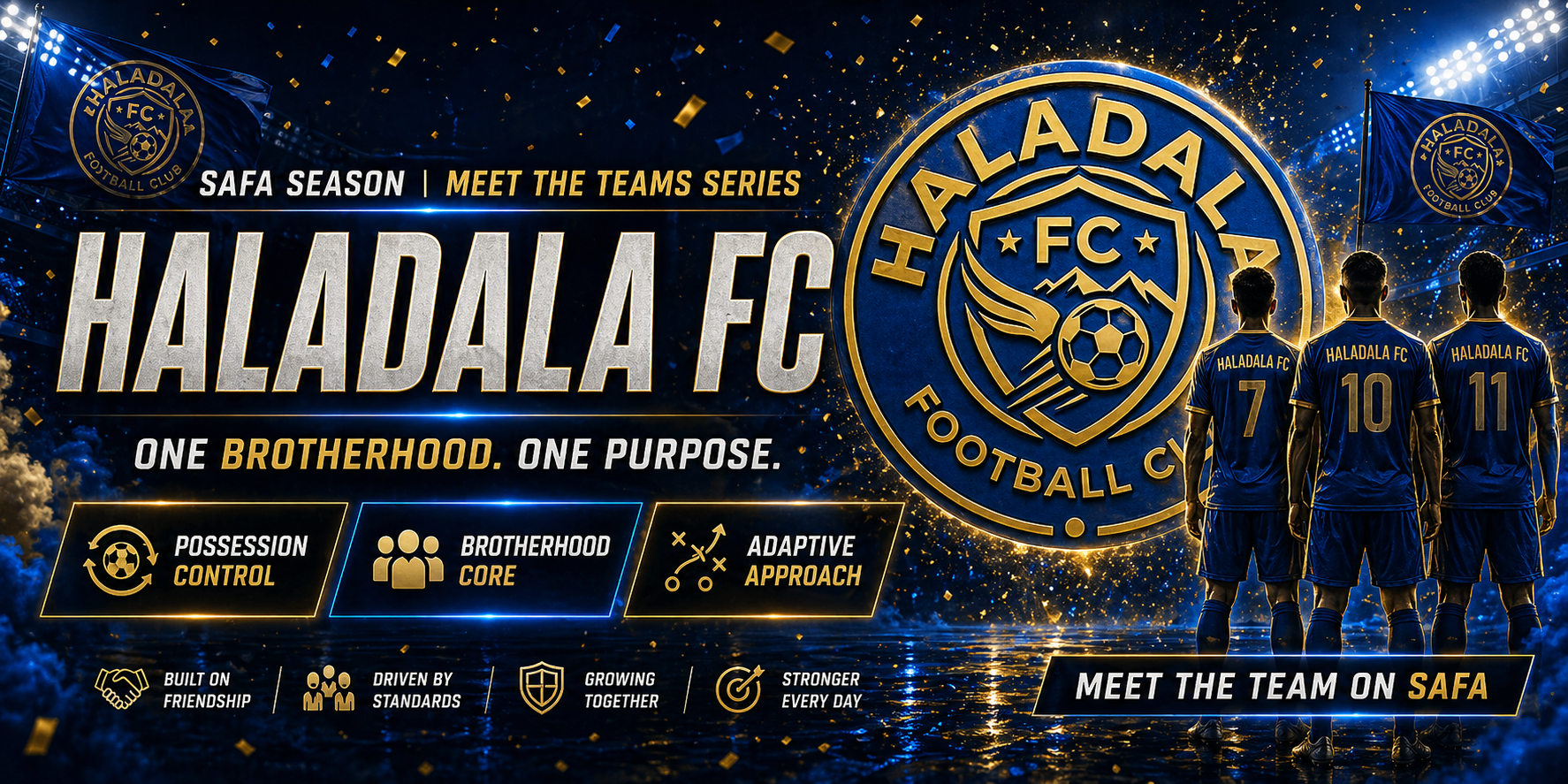

Part of the SAFA Central Team Spotlight Series
Football teams often reveal themselves long before results do.
Not through trophies or league finishes, but through smaller details. The way players speak about each other. The way setbacks are handled. The way standards are introduced and, more importantly, accepted.
That is where Haladala FC seem most interesting.
A Bangladeshi side formed in 2026, they are still early in their journey. New to organised Pro Clubs, new to league structures, still learning the rhythms and demands of competitive football.
But underneath that newness sits something a little more stable.
Connection.
This was never a team assembled through aggressive recruitment or lofty promises. It began simply enough — a group of players trying Pro Clubs together for the first time, enjoying the game for what it was.
Nothing more.
At least initially.
When Enjoyment Becomes Expectation
Many teams are happy to remain casual.
Haladala were not.
Somewhere in that early phase, the tone shifted. The enjoyment stayed, but another layer was added to it.
That shift appears to centre around one figure.
Speed.
Within the group, his role seems clear. Not merely another player, but the individual who pushed standards upwards. The one who introduced competitiveness without making the environment heavier than it needed to be.
That is often a difficult balance to strike.
Too much intensity can drain the fun from a young side. Too little leaves the group drifting.
Haladala seem to have found a middle ground.
They still sound like a team built on friendship. But they now behave like one with purpose.
More Brotherhood Than Roster
There is a tendency in football to overuse certain words.
“Family” is usually one of them.
But when Haladala describe themselves that way, it feels less performative and more observational.
That sense of closeness appears central to everything they do.
Old friends, newer additions, familiar personalities, shared time. The kind of chemistry that cannot be manufactured quickly and rarely survives if it is not genuine.
For a side still adapting to structured competition, that internal trust may be as valuable as any tactical advantage.
Teams can improve systems.
Building cohesion is harder.
Control as an Identity
On the pitch, Haladala lean towards patience.
They are possession-based, preferring to dictate tempo rather than react to it. The aim is clear enough — value the ball, avoid unnecessary risk, force opponents to work harder without possession.
Their preferred shape is a 3-5-2.
A formation that suits what they are trying to become. Numerical presence in central areas, flexibility across phases, enough width without losing balance.
But they are not rigid.
If matches ask different questions, Haladala appear willing to offer different answers. There is adaptability in their approach, which for a younger side is usually a healthy sign.
Dogmatism rarely ages well.
Early Days, Real Ambition
This remains a relatively inexperienced team in organised league football.
A few individuals bring prior experience, but for much of the squad this is unfamiliar territory.
That could invite caution.
Instead, Haladala project something quieter.
No dramatic statements. No unrealistic promises.
Only the suggestion that they want to compete properly, improve consistently, and perhaps surprise a few teams along the way.
There is something sensible about that.
Ambition grounded in realism.
Respectful Rivalry
Their emerging rivalry with Not in Prime adds an interesting subplot.
Not because of bitterness.
Quite the opposite.
One of Not in Prime’s key figures, RootZero, reportedly played an important role in helping Haladala navigate their early Pro Clubs journey. That history gives the fixture an unusual tone — competitive, but without hostility.
The internal comparison is telling.
Goku and Vegeta.
A rivalry built less on dislike and more on mutual sharpening.
Football could do with more of those.
A Team Still Becoming Itself
Haladala are unfinished.
That is not criticism. Merely description.
Most worthwhile projects are.
What matters is that there appears to be something worth developing here — a strong internal culture, improving standards, tactical flexibility, and a group that seems determined not to lose itself while becoming more competitive.
That last part is often where teams go wrong.
Haladala seem aware of it.
And perhaps the best summary of where they are right now came not from a captain or manager, but from one teammate speaking directly to Speed.
“You once told me to give you a sign when significant improvement is done of the team. Well, after seeing how the team is playing for the last few weeks, after all the struggles we faced bringing the team to this point, I can tell you this now — we might not win the league. But we very well will try our best to.”
For now, that feels like an honest reflection.
A team not yet defined by outcomes.
But clearly moving towards something.